Liquid net worth: what it is and how to work it out
Liquid net worth is the money you could get to within days or weeks without selling your home or breaking into a pension, minus what you owe. For someone who owns a home, it's usually much smaller than their total net worth, and it can even be negative while they're doing fine.
What counts as liquid
Liquid net worth = liquid assets − debts
Liquid assets usually means:
- cash in current and savings accounts
- investments you can sell any working day, like shares and funds in an ordinary brokerage account
- crypto, if you're comfortable calling it liquid (it can be sold quickly, but the price can move a lot while you do)
It usually leaves out:
- pensions and other retirement accounts, because taking money out early is often impossible or comes with penalties
- your home, other property, a car, art
- deposits you can't get back yet, such as a rental deposit or a fixed-term deposit
A worked example
Sofia lives in Valencia. A month ago she added up her net worth for the first time and got EUR 222,800, most of which is the flat she lives in and a pension she can't draw on for 25 years. In October her boiler broke and her car needed a new clutch in the same week, and she had to find EUR 4,000.
Here's her full list, all in euros. The figures are illustrative.
| Account | Category | Balance |
|---|---|---|
| Current account | Liquid | 6,500 |
| Savings account | Liquid | 18,000 |
| Brokerage account | Liquid | 41,000 |
| Crypto | Liquid | 3,500 |
| Pension | Illiquid, trackable | 62,000 |
| Flat | Illiquid, estimated | ≈ 340,000 |
| Car | Illiquid, estimated | ≈ 14,000 |
| Mortgage | Debt | 255,000 |
| Car loan | Debt | 6,000 |
| Credit card | Debt | 1,200 |
Total assets are EUR 485,000 and total debts are EUR 262,200, so net worth is 485,000 − 262,200 = EUR 222,800.
Liquid assets: 6,500 + 18,000 + 41,000 + 3,500 = EUR 69,000.
Two ways to work it out
Subtracting all debts
The strict version, and the one most definitions use, takes every debt off:
69,000 − 262,200 = EUR −193,200
That looks alarming, but it's normal for anyone with a mortgage. It only means she couldn't repay every debt tomorrow from her liquid money, which no one expects her to, since the mortgage is secured on the flat.
Leaving out the mortgage
A second version leaves the mortgage out, since it would be paid off from selling the flat:
69,000 − (6,000 + 1,200) = EUR 61,800
This is the more useful figure for an emergency like the boiler. She could get to about EUR 61,800 after clearing the short-term debts she'd want to pay off anyway.
Some people leave the car loan out as well, for the same reason, which gives 69,000 − 1,200 = EUR 67,800.
The strict version is the most common definition and the most cautious one, while the second is often more useful day to day.
What liquid net worth is good for
Sofia's liquid assets are 69,000 ÷ 485,000 = 14.2% of everything she owns. If that share keeps falling because every spare euro goes into the flat and the pension, she'll have less to fall back on for the next unexpected bill.
It also gives her a sense of how long she could manage without income. She spends about EUR 3,000 a month, so EUR 61,800 would last about 20 months. Only the cash, EUR 24,500, is unaffected by a bad week in the markets, and that would cover about 8 months.
Her debts are 262,200 ÷ 485,000 = 54.1% of her assets, almost all of it mortgage. Over the years she'd want that share to fall.
Things to watch
Selling investments has a cost. Sofia might pay tax on gains and some fees, and she'd get whatever the market price was that week. A 10% fall would take EUR 4,100 off the brokerage account.
Some countries let you take part of a pension early, others not before a set age. Most people leave pensions out of liquid net worth, because they're rarely reachable when you'd need them.
A dollar savings account is liquid, but its value in euros moves with the rate. The guide on the currency effect covers that.
The flat's value has no effect on liquid net worth at all, so it doesn't matter here if you're unsure what your home is worth. The guide on valuing illiquid assets covers how to value the flat itself.
Where common accounts fall
Some accounts sit on the line:
| Account | Usually | Reason |
|---|---|---|
| Notice savings account (30 to 90 days) | Liquid | You'll have it within weeks |
| Fixed-term deposit | Illiquid | Locked until it matures, or you pay to break it |
| Shares in an ordinary brokerage account | Liquid | Sold and paid out within a few working days |
| Shares in a pension wrapper | Illiquid | Same shares, but you can't take the money out |
| Employer shares still vesting | Illiquid | Not yours to sell yet |
| Money lent to a friend | Illiquid | Comes back when they can pay |
| Rental deposit | Illiquid | Comes back when you move out |
A useful test is whether you could have the money next month. If the answer is "probably, at a cost", count it as liquid and keep the cost in mind. If the answer is no, treat it as illiquid.
Working out your own liquid net worth
- List every account with its balance on one date, in one currency. If you hold more than one currency, see tracking net worth across currencies.
- Mark each account as liquid, illiquid or debt.
- Add up the liquid ones.
- Decide which debts to subtract: all of them, or all except mortgages and other loans secured on illiquid assets. Write the choice down.
- Subtract.
In a spreadsheet, a category column and a SUMIF on it does most of the work.
Liquid net worth in Thallo
Thallo works out liquid net worth from the type of each account. When you add an account you pick its type, such as Cash, Retirement or Mortgage. Each type belongs to one of four categories:
- Liquid: cash, brokerage, crypto
- Illiquid, trackable: pensions, deposits
- Illiquid, estimated: car, property, art
- Debt: loans, mortgages, credit cards
With Sofia's ten accounts in one place, the overview would show her net worth, assets, debt and liquid net worth side by side, with a breakdown by category. Thallo uses the stricter version, taking her liquid assets and subtracting all of her debt, mortgage included, so it would show EUR −193,200.
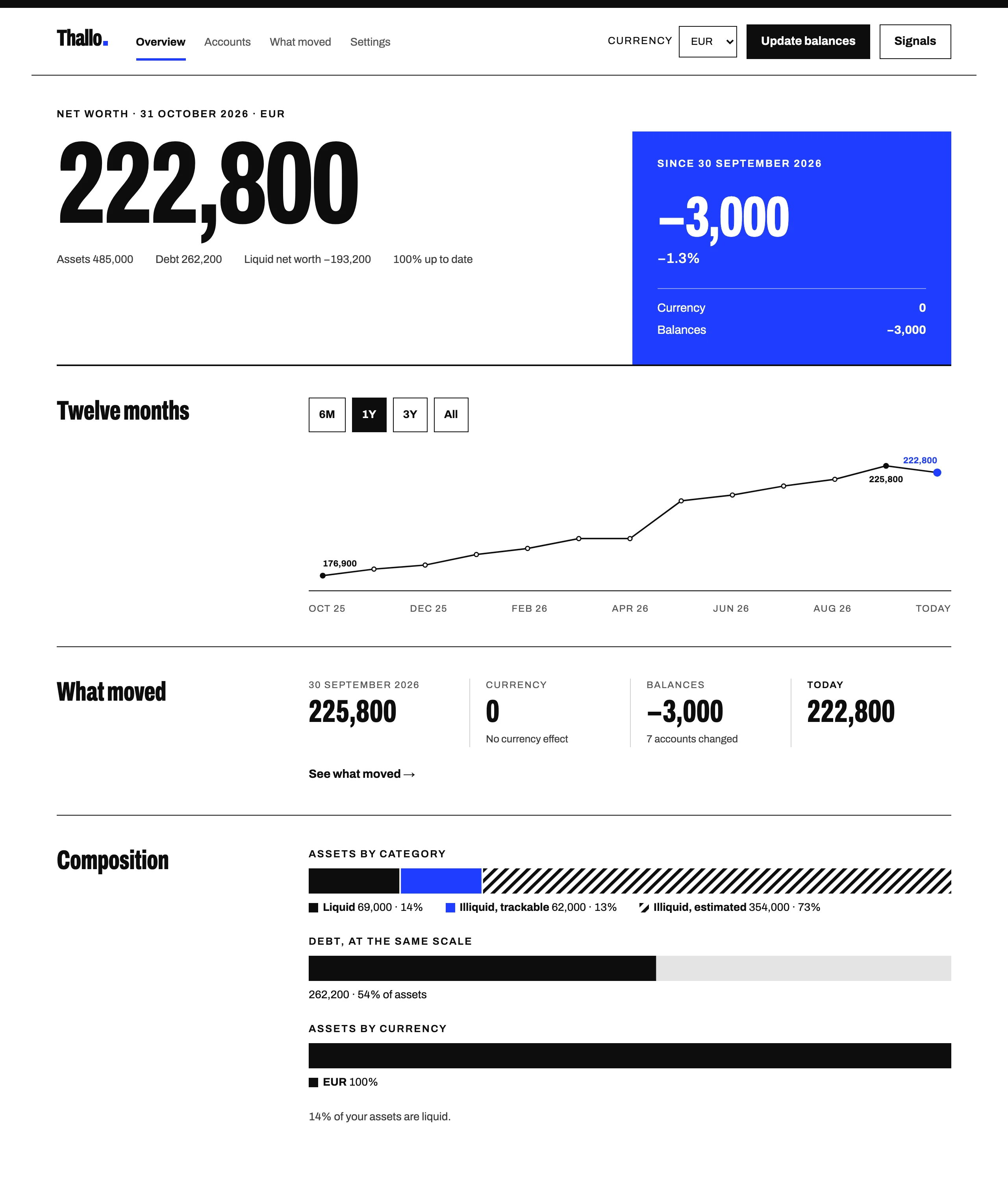
The ratios include liquid share of assets and debt to assets, the two percentages worked out for Sofia above, rounded to 14% and 54%. Over the months they show whether the money she could reach quickly is growing or shrinking as a share of everything she owns.
Start free. Once your accounts are in, your liquid net worth is shown on the overview.