How to value your car, property or a pension abroad
If you're wondering whether to include your house in your net worth, the answer is yes, at a careful estimate of what it would sell for, with the mortgage counted as a debt. A car and a pension abroad belong in it too. None of them has a price you can look up in an app, so this guide goes through how to put a sensible number on each.
Including your house in your net worth
Net worth is what you own minus what you owe, and a home you own is part of that. If you left the home out but counted the mortgage, you'd look poorer than you are, and leaving both out would miss the biggest asset and the biggest debt most people ever have.
How to count it:
- Count the home at an honest estimate of what it would sell for.
- Count the mortgage as a debt, in full.
- Look at your total both with and without the home, if that helps you think about it. Liquid net worth goes further and leaves out everything you couldn't sell quickly. See liquid net worth.
Some people leave the home out because they never plan to sell. That's a reasonable choice, as long as the mortgage comes out too.
The example
Lukas lives in Amsterdam and counts his money in euros. His bank account and brokerage are easy to track, because the apps show a current balance. The other three things he owns are harder: a 72 m² flat with a mortgage on it, a Škoda, and a UK workplace pension from the years he worked in London, which sends him one statement a year.
Valuing property
Start with three or four recent sales of similar homes nearby: same area, similar size, similar condition. Many countries have a property portal or land registry that shows sold prices. Asking prices are less useful, because homes often sell for less.
Say Lukas finds three sold flats nearby that work out to EUR 5,100, EUR 4,800 and EUR 5,400 per m² (illustrative figures). The average is EUR 5,100 per m².
72 × 5,100 = ≈ EUR 367,200
Selling would mean paying agent fees and other costs, which vary a lot by country. Some people take these off to get a figure for what they'd actually receive. If Lukas assumes 3% for the example, that's EUR 11,016 off, giving ≈ EUR 356,184.
What you paid is useful for tax, but it isn't what the flat is worth now. Official valuations for property tax, where a country publishes them, are a fair starting point, though they're usually based on older sales and lag the market.
A property estimate is accurate to within a few percent at best, so you could round this to EUR 365,000. The rest of this guide keeps EUR 367,200 so the sums are easy to follow.
Updating the value once a year is enough, because prices change slowly and there won't be new comparable sales every month.
Recording the mortgage
The mortgage is simpler, because it's a debt with an exact balance. The bank shows what you owe, usually in the app or on an annual statement. Lukas owes EUR 210,000. His equity in the flat is 367,200 − 210,000 = EUR 157,200.
Record the flat and the mortgage as two separate accounts rather than as one "equity" number. That way, when you pay down the mortgage you can see the debt fall, and when you revalue the flat you can see that change separately.
Valuing a car
A car is easier to value than a flat, because there are hundreds of cars like his for sale at any time.
- Look up the exact model, year, engine and mileage in a used-car price guide or on two or three listing sites.
- Note asking prices for close matches. Lukas finds EUR 19,500, EUR 21,000 and EUR 20,200.
- Take the middle one: EUR 20,200.
- Knock some off, because asking prices run higher than sale prices, and a dealer charges more than they'd pay you. Lukas takes 10% off: 20,200 × 0.9 = ≈ EUR 18,180.
Update it once a year, or sooner if something happens to the car. If you'd rather not look it up each time, you can take a fixed percentage off every year instead. At an assumed 15%, Lukas's car would be ≈ EUR 15,453 next year. That's a rough method, but it's closer to reality than leaving the value unchanged.
Valuing a pension abroad
Defined contribution pensions
Most workplace pensions are now this kind. You and your employer pay into a pot, the pot is invested, and the statement shows its current value, which is the number to use. Lukas's statement says GBP 48,300.
Defined benefit pensions
Some pensions, often called final salary pensions, don't have a pot. They promise a yearly income from a certain age. The statement shows that income, not a value. To put a number on it, you can ask for a transfer value: what the scheme would pay out if you moved the pension elsewhere. In the UK you can usually request one, and the first request in a year is normally free. If you can't get one, leave the pension out of the total and make a note of it separately. It's still worth something, but a guess could be far off, so a note is safer.
Lukas's pension is in pounds, and he counts in euros. Keep the balance in pounds and convert when you add things up. At an illustrative rate of 1 GBP = EUR 1.15:
48,300 × 1.15 = EUR 55,545
When the pound rises or falls against the euro, this figure changes too, even though the statement stays the same. That's a real change in what the pension is worth to him in euros, and the guide on the currency effect explains how to separate it from the pension's own growth.
Update the pension as often as a new number exists. For most foreign pensions that's once a year, when the statement arrives. If the provider has a website with a current value, quarterly is plenty.
Lukas's full picture
| Account | Category | Value in EUR |
|---|---|---|
| Bank accounts | Liquid | 15,000 |
| Brokerage | Liquid | 30,000 |
| UK pension (GBP 48,300) | Illiquid, trackable | 55,545 |
| Flat | Illiquid, estimated | ≈ 367,200 |
| Car | Illiquid, estimated | ≈ 18,180 |
| Mortgage | Debt | −210,000 |
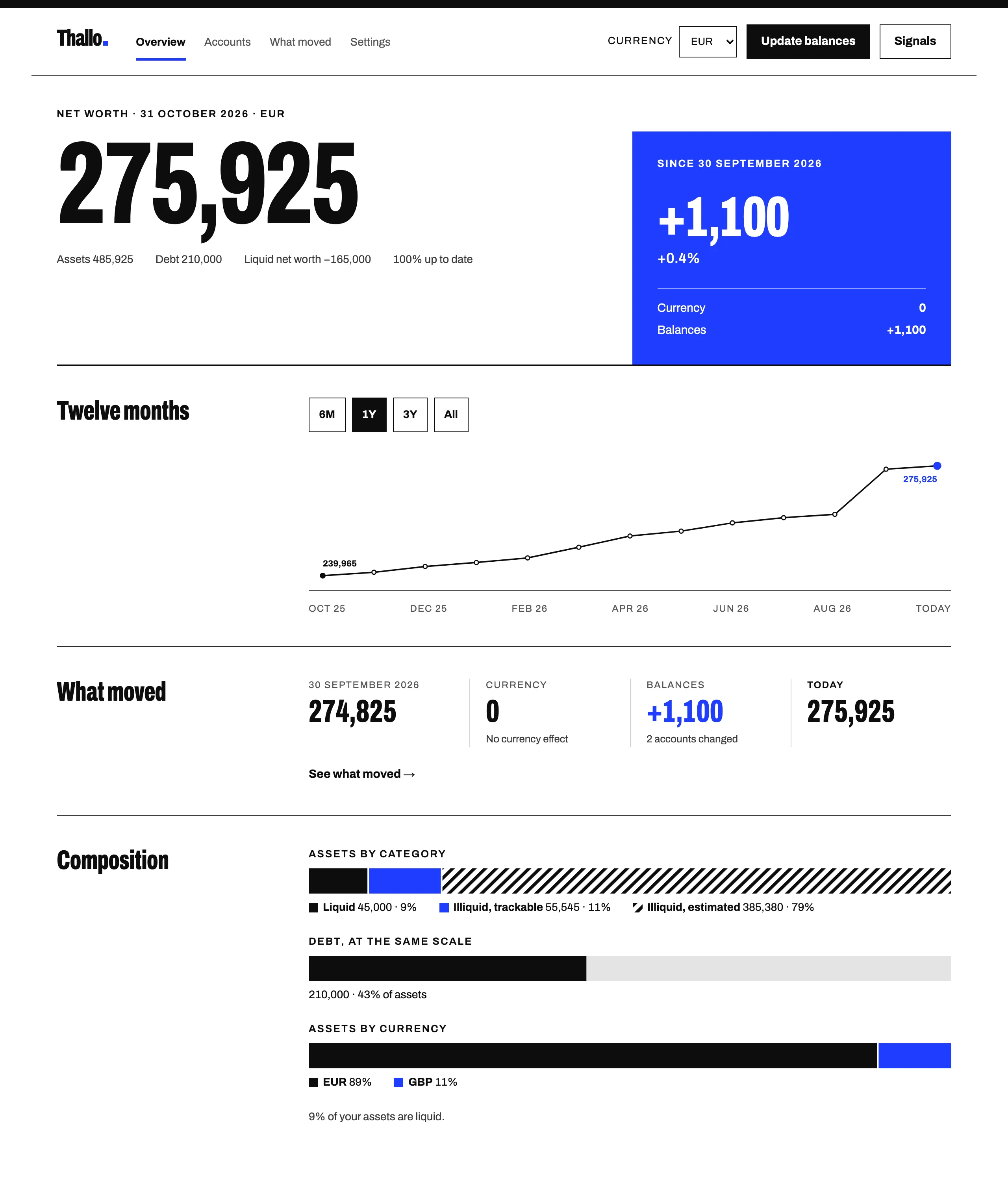
| Net worth | ≈ 275,925 |
The equity in the flat, EUR 157,200, is about 57% of his net worth. If his estimate of the flat is 5% too high, his net worth is overstated by about EUR 18,360. The bank, broker and pension figures come from someone else, while the flat and the car are his own estimates, so nearly all the uncertainty in his total comes from those two.
Valuing a home, car and pension in Thallo
In Thallo, Lukas could keep all of these in one place: the flat and its mortgage, the car and the UK pension in pounds, alongside his bank and brokerage in euros. There are account types for Property, Vehicle, Art, Mortgage, Loan and Retirement, and each account has its own currency.
Every account falls into one of four categories: Liquid; Illiquid, trackable (someone else reports the number, like a pension); Illiquid, estimated (your own estimate, like the car and flat); and Debt. The overview shows your net worth broken down by these categories, so Lukas could see how much of his total rests on his own estimates. It also shows liquid net worth, which leaves out the flat, the car and the pension, next to the full total.
Your own estimates are marked with ≈ in your list of accounts. You choose how often each account should be updated, for example yearly for the flat and car and quarterly for the mortgage, and Thallo marks an account as out of date once that time has passed. Signals are on by default, and the weekly list might point out that your car's value hasn't changed in 12 months.
Start free. You can put in rough figures for the flat and the car now and change them once you've looked at sold prices.