How to track your net worth across several currencies
Mette is Danish and has worked in Singapore since 2021, and she'd like to track her net worth across the three currencies her money is in. She has savings in Singapore, a Danish pension from her first job, a US brokerage account from a year in the States, and a credit card balance.
Her four numbers look like this:
| Account | Currency | Balance |
|---|---|---|
| Savings account | SGD | 42,000 |
| Danish pension | DKK | 380,000 |
| US brokerage | USD | 25,000 |
| Credit card (debt) | SGD | 3,200 |
If she simply added these up she'd get 443,800, but that figure doesn't mean anything, because most of it is Danish kroner (each worth about a fifth of a Singapore dollar) mixed with two different kinds of dollar. The way round this is to pick one currency to count in and convert every account on the same date. You also keep the original balances, so that later on you can tell what actually changed.
Choosing a display currency
Your display currency is the one you count everything in. It doesn't have to be the currency most of your money is in. A good choice is the currency you spend in now, or expect to spend in later. For Mette that's probably Singapore dollars today, but if she plans to move home in five years, Danish kroner may make more sense.
You can change your mind later without losing anything, because a total in one currency converts straight into another. Switching back and forth often does make month-to-month changes harder to compare in your head, so most people settle on one and leave it.
Recording each account in its own currency
Write down each balance in the currency the account is held in, and don't convert it at the moment you record it.
If Mette records her US brokerage as "SGD 32,600" in March, she has fixed March's exchange rate into her history. When she looks back in December, she won't be able to tell whether the account grew or the dollar did. If she records "USD 25,000" instead and converts only when she wants a total, she can rebuild any date with that date's rate.
Debts work the same way. Record a loan in the currency you owe it in, and convert it like everything else.
Converting with one rate source on one date
When you convert, use one source of rates and take all of them for the same day. If you mix your bank's app rate for one account with a rate from a search engine for another, you add small errors that you can't trace later.
A common free source is the European Central Bank's euro reference rates. The ECB publishes them every working day, usually around 16:00 CET, for about 30 currencies against the euro. The ECB says the rates are for information only, and you won't get them at a bank, but that's fine for a net worth total because you aren't changing any money.
Because the ECB quotes every currency per 1 euro, you can get any other pair by dividing. These rates are illustrative and rounded to keep the arithmetic readable:
- 1 EUR = SGD 1.50
- 1 EUR = DKK 7.50
- 1 EUR = USD 1.15
So 1 DKK is worth 1.50 ÷ 7.50 = SGD 0.20, and 1 USD is worth 1.50 ÷ 1.15 = SGD 1.3043.
Worked example in Singapore dollars
With those rates, Mette's accounts convert like this:
| Account | Balance | Rate to SGD | Value in SGD |
|---|---|---|---|
| Savings account | SGD 42,000 | 1 | SGD 42,000.00 |
| Danish pension | DKK 380,000 | 0.20 | SGD 76,000.00 |
| US brokerage | USD 25,000 | 1.3043 | SGD 32,608.70 |
| Credit card | SGD 3,200 | 1 | −3,200.00 |
| Net worth | SGD 147,408.70 |
The pension is her biggest asset, at about half the total. In the unconverted sum it looked like 86%.
As a check, you can do the same sum in Danish kroner. Each SGD is worth 7.50 ÷ 1.50 = DKK 5, and each USD is worth 7.50 ÷ 1.15 = DKK 6.5217:
| Account | Value in DKK |
|---|---|
| Savings account | DKK 210,000.00 |
| Danish pension | DKK 380,000.00 |
| US brokerage | DKK 163,043.48 |
| Credit card | −16,000.00 |
| Net worth | DKK 737,043.48 |
DKK 737,043.48 × 0.20 = SGD 147,408.70, which matches. If your two totals don't agree like this, one of your rates is probably from a different day or a different source.
When exchange rates change
Say that a month later every balance is the same, but the dollar has weakened to USD 1.20 per euro (still illustrative). The US brokerage still holds USD 25,000, but in Singapore dollars it's now 25,000 × 1.50 ÷ 1.20 = SGD 31,250.00.
That's SGD 1,358.70 less than last month, even though Mette didn't touch anything. This is the currency effect. It's a real change, since she'd get less if she sold and moved the money to Singapore, but it isn't the same as her investments falling. The guide on why your net worth changed when you didn't do anything shows how to split the two.
Common mistakes
Reference rates only come out on working days, so for a Saturday you'd use the rate from the Friday before.
The ECB list covers the Thai baht, the Singapore dollar and most major currencies, but not the UAE dirham or the Vietnamese dong. For those you'll need a second source, so write down which one you used.
Keep the rates you used for each date next to the balances. If you only have today's rates, you can't rebuild or check last year's total.
Use rates from the date you want the total for. If a pension figure is from June, converting it at today's rate gives a fair estimate of what it's worth now, as long as the balance hasn't changed.
When you do move money, your bank will give you a worse rate than the reference rate and charge fees as well. That's the cost of moving the money, so leave it out of your net worth until you actually make the transfer.
Setting it up in a spreadsheet
This layout works well over several years:
- One sheet of balances: one row per account, with columns for account name and currency, then one column per date.
- One sheet of rates: one row per currency and one column per date, all quoted against the same base (for example units per 1 EUR, or per 1 USD).
- One sheet that multiplies each balance by the matching rate for that date and adds up the results.
The rates sheet is the part that usually goes wrong, because you have to fill it in every month for every currency and get the formulas to pick the right column. The free net worth spreadsheet template has this structure ready if you'd like to start there.
Tracking net worth in multiple currencies with Thallo
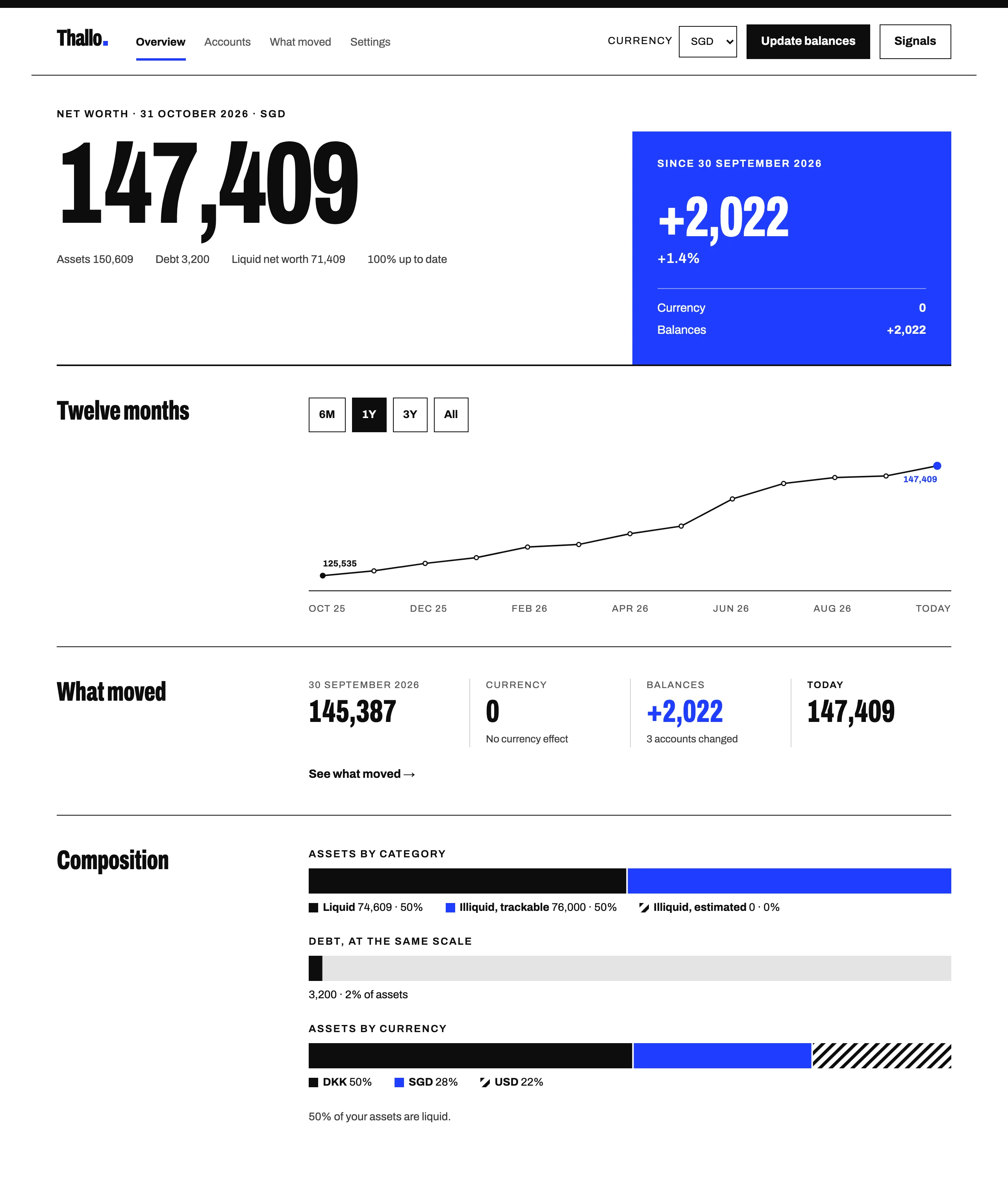
In Thallo, Mette's Singapore savings, Danish pension and US brokerage would each stay in SGD, DKK and USD, and her total would be shown in whichever display currency she picks. She can switch it any time, for example from SGD to DKK, and every total and chart is then shown in the new currency.
Thallo fetches exchange rates every day from a free public service, Frankfurter, which publishes rates from central banks and official sources, and stores them, so any past date can be rebuilt without a rates sheet. When she hasn't updated an account, its balance is held steady and converted at the current rate, which is the fair estimate described above.
The overview breaks her total down by currency, which would show that roughly half of it is in kroner, next to her net worth, the change since last month-end and a 12-month trend. When the dollar weakens as in the example, What moved shows how much of the change came from exchange rates and how much from her own balances, for any two dates she picks.
Start free, and pick your display currency first, since everything else is shown in it.