Why your net worth changed when you didn't do anything
Anders lives in Copenhagen and counts his money in Danish kroner. He has a savings account at home and a dollar account left over from two years in New York. He also owes baht on a loan he took out for his share of a flat in Bangkok. Because two of his three accounts aren't in kroner, part of every change in his net worth comes from exchange rates, and that part is called the currency effect.
At the start of the month his total was DKK 129,810.92, and by the end it was DKK 133,474.59, a rise of DKK 3,663.68.
He knows he saved DKK 2,000 and paid down some of the loan, and the US account didn't change at all. What he'd like to know is how much of the rise came from what he did and how much came from exchange rates. This guide works it out with his numbers, and the same method works for any mix of accounts and currencies.
Two reasons a multi-currency total changes
If you add up money held in several currencies, your total changes for two separate reasons:
- Balance changes. The number in the account itself changed. You saved, spent, repaid, or the investments inside it went up or down.
- Currency effect. The balance didn't change, but the exchange rate did, so it's worth more or less in your display currency.
Both are real changes: when the dollar falls against the krone, Anders's dollars buy fewer kroner. But you'd usually react to them differently. Spending more than you meant to is something you might want to fix, while a small fall in the dollar usually isn't, unless you're about to bring the money home.
The example, with the rates
All figures here are illustrative. The rates are quoted per 1 euro, the way the European Central Bank publishes them.
| Date | DKK per EUR | USD per EUR | THB per EUR |
|---|---|---|---|
| Start (d0) | 7.46 | 1.08 | 38.0 |
| End (d1) | 7.46 | 1.10 | 39.0 |
For the value of one dollar or one baht in kroner, divide the krone rate by the other one.
| Date | 1 USD in DKK | 1 THB in DKK |
|---|---|---|
| Start | 7.46 ÷ 1.08 = 6.9074 | 7.46 ÷ 38.0 = 0.19632 |
| End | 7.46 ÷ 1.10 = 6.7818 | 7.46 ÷ 39.0 = 0.19128 |
So over the month the dollar lost about 1.8% against the krone, and the baht lost about 2.6%.
His three accounts:
| Account | Currency | Start balance | End balance |
|---|---|---|---|
| A: savings | DKK | 100,000 | 102,000 |
| B: US account | USD | 10,000 | 10,000 |
| C: Thai loan (debt) | THB | 200,000 | 190,000 |
Step 1: the total on each date
Convert each balance at that date's rate. The loan is a debt, so it counts as a minus.
| Account | Start, in DKK | End, in DKK |
|---|---|---|
| A: savings | 100,000.00 | 102,000.00 |
| B: US account | 69,074.07 | 67,818.18 |
| C: Thai loan | −39,263.16 | −36,343.59 |
| Total | 129,810.92 | 133,474.59 |
Change: 133,474.59 − 129,810.92 = DKK 3,663.68.
Step 2: the currency effect
For each account, work out how much its value would have changed from the rate move alone, as if the balance had stayed put.
Currency effect = old balance × (new rate − old rate)
- A: 100,000 × (1 − 1) = 0, since a krone is always worth one krone.
- B: 10,000 × (6.7818 − 6.9074) = DKK −1,255.89. The dollar fell, so the account lost value in kroner.
- C: the debt was −200,000 baht. −200,000 × (0.19128 − 0.19632) = DKK +1,006.75. The baht fell too, so the loan cost less in kroner, which is good for him.
Total currency effect: 0 − 1,255.89 + 1,006.75 = DKK −249.14.
Step 3: the balance changes
Next, work out the part that came from what Anders did himself. Take the change in each local balance and value it at the new rate.
Balance effect = (new balance − old balance) × new rate
- A: (102,000 − 100,000) × 1 = DKK +2,000.00
- B: (10,000 − 10,000) × 6.7818 = 0
- C: the debt went from −200,000 to −190,000 baht, a change of +10,000. 10,000 × 0.19128 = DKK +1,912.82
Total balance effect: DKK +3,912.82.
Step 4: check that it adds up
−249.14 + 3,912.82 = 3,663.68, which is exactly the change from step 1.
| Account | Currency effect | Balance changes | Total change |
|---|---|---|---|
| A: savings | 0.00 | +2,000.00 | +2,000.00 |
| B: US account | −1,255.89 | 0.00 | −1,255.89 |
| C: Thai loan | +1,006.75 | +1,912.82 | +2,919.57 |
| Total | −249.14 | +3,912.82 | +3,663.68 |
Anders added DKK 3,912.82 by saving and repaying. Exchange rates reduced his total by DKK 249.14, because the fall in the dollar cost him more than the fall in the baht saved him on the loan.
The two formulas always add up exactly, because old balance × old rate + old balance × (new rate − old rate) + (new balance − old balance) × new rate = new balance × new rate.
Doing the split in the other order
You could also do it the other way round: value the balance change at the old rate, and apply the rate move to the new balance. With Anders's numbers that gives a currency effect of DKK −299.48 and balance changes of DKK +3,963.16. The total is the same, but the split is slightly different.
Both are correct. The difference comes from the 10,000 baht he repaid: one method counts the rate change on that money and the other doesn't. Whichever you pick, use it every month so the months can be compared. The method above is the more common choice, because its currency effect is what would have happened if he'd done nothing.
How big the currency effect can get
Over one month the currency effect is often small, as it was for Anders, but over a year it can be large. If a third of your wealth is in dollars and the dollar falls 10% against your display currency, your total drops by over 3%, even if none of your balances change.
The split helps most when:
- you're paid in one currency and live in another
- you have a pension or property in a country you've left
- you have a debt in a different currency from your income
- you're checking whether your savings plan is on track, and want to leave out the effect of exchange rates
This only works if you record each balance in its own currency, before converting. The guide on tracking net worth in multiple currencies covers how to set that up.
Doing it in a spreadsheet
You need, for each account: old balance, new balance, old rate, new rate. Then two formula columns:
- Currency effect:
old_balance * (new_rate - old_rate) - Balance effect:
(new_balance - old_balance) * new_rate
Enter debts as negative numbers. Sum both columns and check they add up to the change in your total. If they don't, a rate or a balance is from the wrong date.
The free currency effect calculator does this for a few accounts without a spreadsheet.
The currency effect in Thallo
Thallo does this calculation for you on the What moved screen. You pick two dates, and it splits the change in your net worth into currency effect and balance changes, with the currency effect for each currency and the balance changes for each account, using the method above. Exchange rates are stored daily, so any two dates work, including ones several months apart.
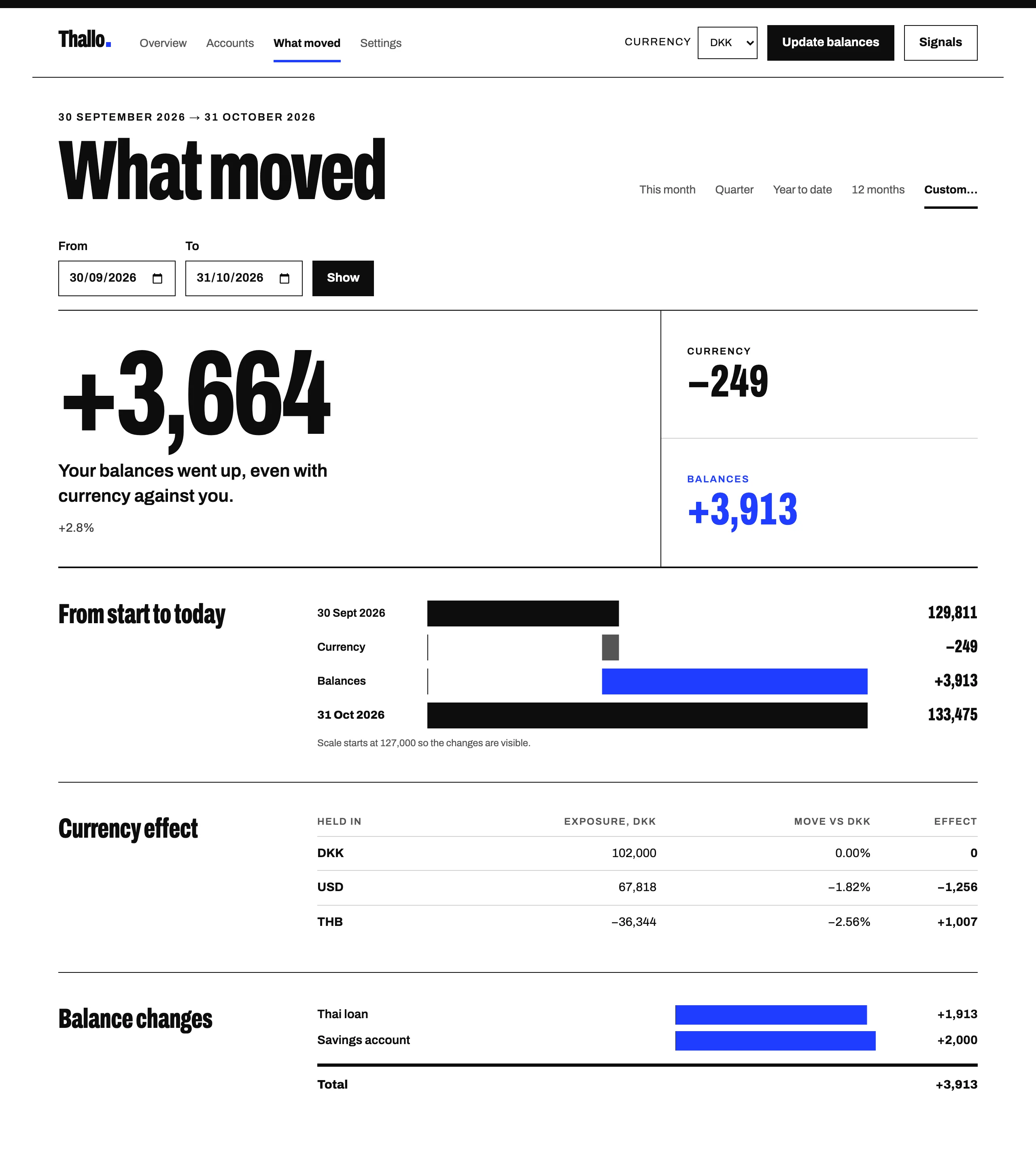
For Anders that would mean his krone savings, his dollar account and the baht loan all in one place, with the total in kroner. The breakdown by currency would show how much of his money is exposed to the dollar and the baht. If an account hasn't been updated between the two dates, its balance is held steady and any change in its value shows up as currency effect, as with his US account. The screen rounds to whole kroner, so Anders would see −249, +3,913 and +3,664.
Signals are on by default, and the weekly list may point out a month where a currency move cost you something, with the amount. If you already have past balances in a spreadsheet, you can import them, so What moved also covers the months before you started.
Start free. What moved works as soon as you've entered balances on two dates.