Paid in dollars, living in euros
This is an illustrative example, not a customer story. The numbers are made up.
Abena Mensah is a freelance product designer in Lisbon. Most of her clients are American and pay into a US dollar account she holds with a money transfer service, while her rent, food and tax are in euros. Every few months she moves some dollars into euros. Her display currency is EUR.
Between April and June the dollar fell from EUR 0.90 to EUR 0.86, and she made one large transfer. This example looks at how those two things show up in her numbers.
Her accounts
| Account | Type | Currency | Balance on 31 March |
|---|---|---|---|
| USD account (clients pay in here) | Cash | USD | USD 22,000 |
| Portuguese current account | Cash | EUR | EUR 4,000 |
| Savings account | Cash | EUR | EUR 6,000 |
| Credit card | Credit card | EUR | EUR 900 |
On 31 March, 1 USD was worth EUR 0.90 and her net worth was EUR 28,900.
Some of the savings is money set aside for tax. Thallo doesn't calculate tax, so she renamed the account "Savings (incl. tax money)".
April to June
- Clients paid her USD 8,000.
- In mid-May she moved USD 11,000 to her savings account, and EUR 9,650 arrived after the fee.
- The current account went from EUR 4,000 to EUR 3,200.
- The card balance went from EUR 900 to EUR 700.
By 30 June the dollar was worth EUR 0.86. She had USD 19,000 in the dollar account, EUR 3,200 in the current account, EUR 15,650 in savings and EUR 700 on the card. Her net worth was EUR 34,490, up EUR 5,590.
In the breakdown by currency, dollars went from about two thirds of her assets to under half, mainly because of the transfer.
Where the quarter's change came from
Account by account, 31 March to 30 June looks like this:
| Account | Currency effect | Balance changes |
|---|---|---|
| USD account | −EUR 880 | −EUR 2,580 |
| Portuguese current account | EUR 0 | −EUR 800 |
| Savings (incl. tax money) | EUR 0 | +EUR 9,650 |
| Credit card | EUR 0 | +EUR 200 |
| Total | −EUR 880 | +EUR 6,470 |
What moved shows the −EUR 880 on its USD row, since all her dollars are in one account.
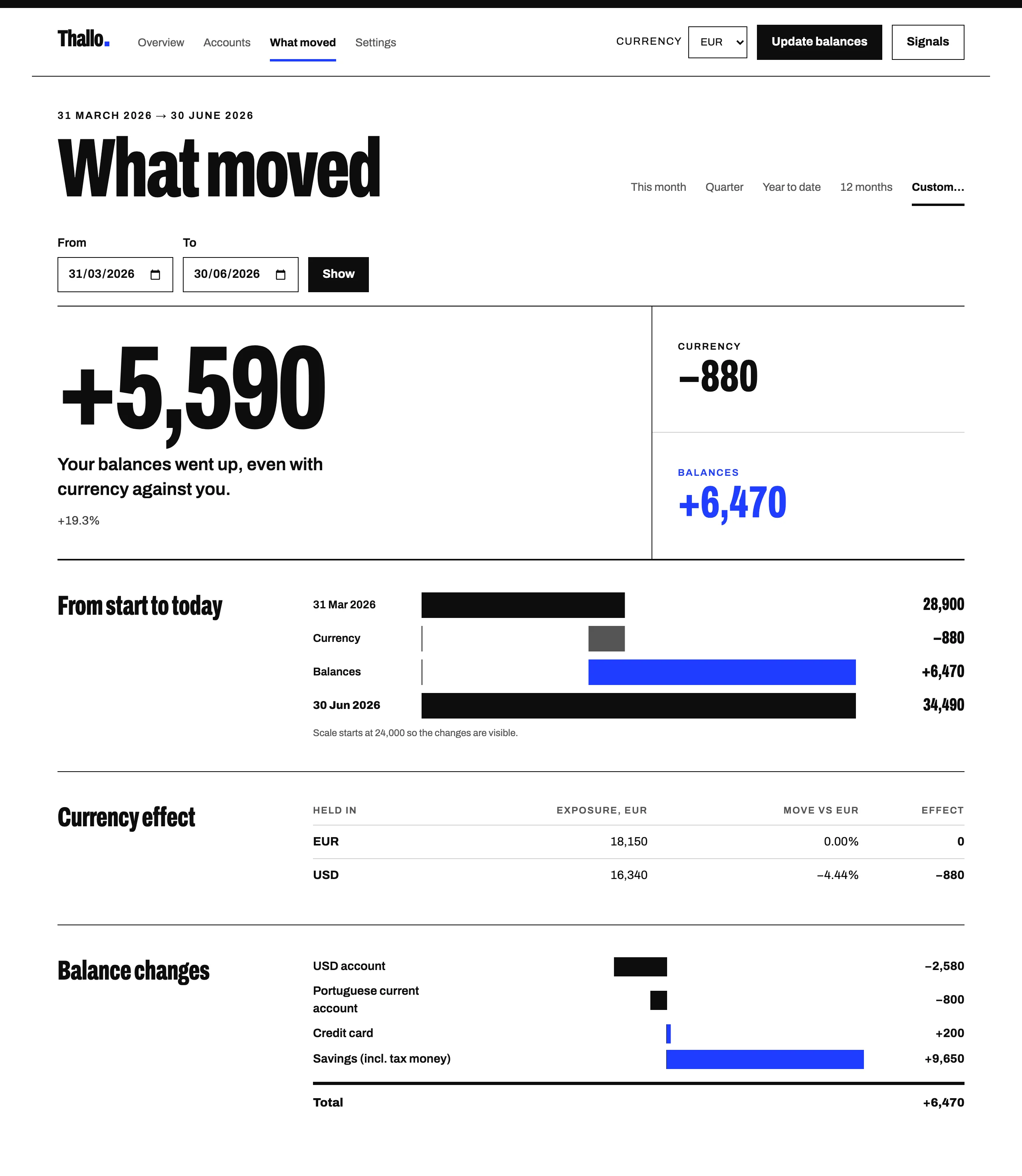
The currency effect is the starting USD 22,000 times the fall in the rate: USD 22,000 × 0.04 = EUR 880. That's what the weaker dollar cost her over the quarter, on the dollars she already had at the start.
The USD account fell by USD 3,000 (USD 8,000 in and USD 11,000 out), which is −EUR 2,580 at the end rate, and savings rose by EUR 9,650. Most of the change in those two lines is her own money moving between accounts. Her Signals that week included: "Your USD account and your savings account moved in opposite directions this quarter. Did you move money between them?", which was the May transfer.
The May transfer
If she'd left the USD 11,000 in dollars, it would have been worth USD 11,000 × 0.86 = EUR 9,460 on 30 June. She got EUR 9,650 in May, so converting then left her about EUR 190 better off, after the fee. The dollar could just as easily have gone up, in which case waiting would have been better.
What she saved
To see what she saved in the quarter, she takes the balance changes and leaves out the transfer. For April to June that was EUR 6,280: USD 8,000 from clients (EUR 6,880 at the end rate), minus EUR 800 from the current account, plus EUR 200 less owed on the card.
The other EUR 190 of the EUR 6,470 is the gain from converting in May rather than at the end-of-June rate.
Start free, and set your display currency to the one you pay rent in.