Salary in Singapore, pension in France
This is an illustrative example, not a customer story. The numbers are made up.
Claire Fontaine is a French engineer who has worked in Singapore for four years. She's paid in Singapore dollars, and her display currency is SGD. Her pension from her first French employer is in euros, and so is the Livret A savings account she opened as a student. This example follows one month, September, and what made up the change in her net worth.
Her accounts on 31 August
| Account | Type | Currency | Balance on 31 August |
|---|---|---|---|
| Singapore current account | Cash | SGD | SGD 14,000 |
| Singapore brokerage | Brokerage | SGD | SGD 30,000 |
| French pension (old employer) | Retirement | EUR | EUR 42,000 |
| Livret A savings | Cash | EUR | EUR 8,000 |
| Credit card | Credit card | SGD | SGD 1,500 |
The pension statement arrives once a year, in March, so the pension is set to a yearly rhythm. The Livret A hardly changes and is set to quarterly, and the other accounts are monthly.
On 31 August, 1 EUR was worth SGD 1.45 and her net worth was SGD 115,000.
What happened in September
- The current account went from SGD 14,000 to SGD 16,500, which was money saved from her salary.
- The brokerage went from SGD 30,000 to SGD 31,200. She hadn't added anything, so that was the market.
- She paid the card down from SGD 1,500 to SGD 1,100.
There were no new numbers for the two French accounts, but the euro rose to SGD 1.50 by 30 September.
The Overview showed her net worth, SGD 121,600, and the change since the last month-end, +SGD 6,600. In the breakdown by currency, her euro accounts made up 61% of her assets. In Singapore dollars they were worth SGD 75,000, up from SGD 72,500, although neither balance had changed.
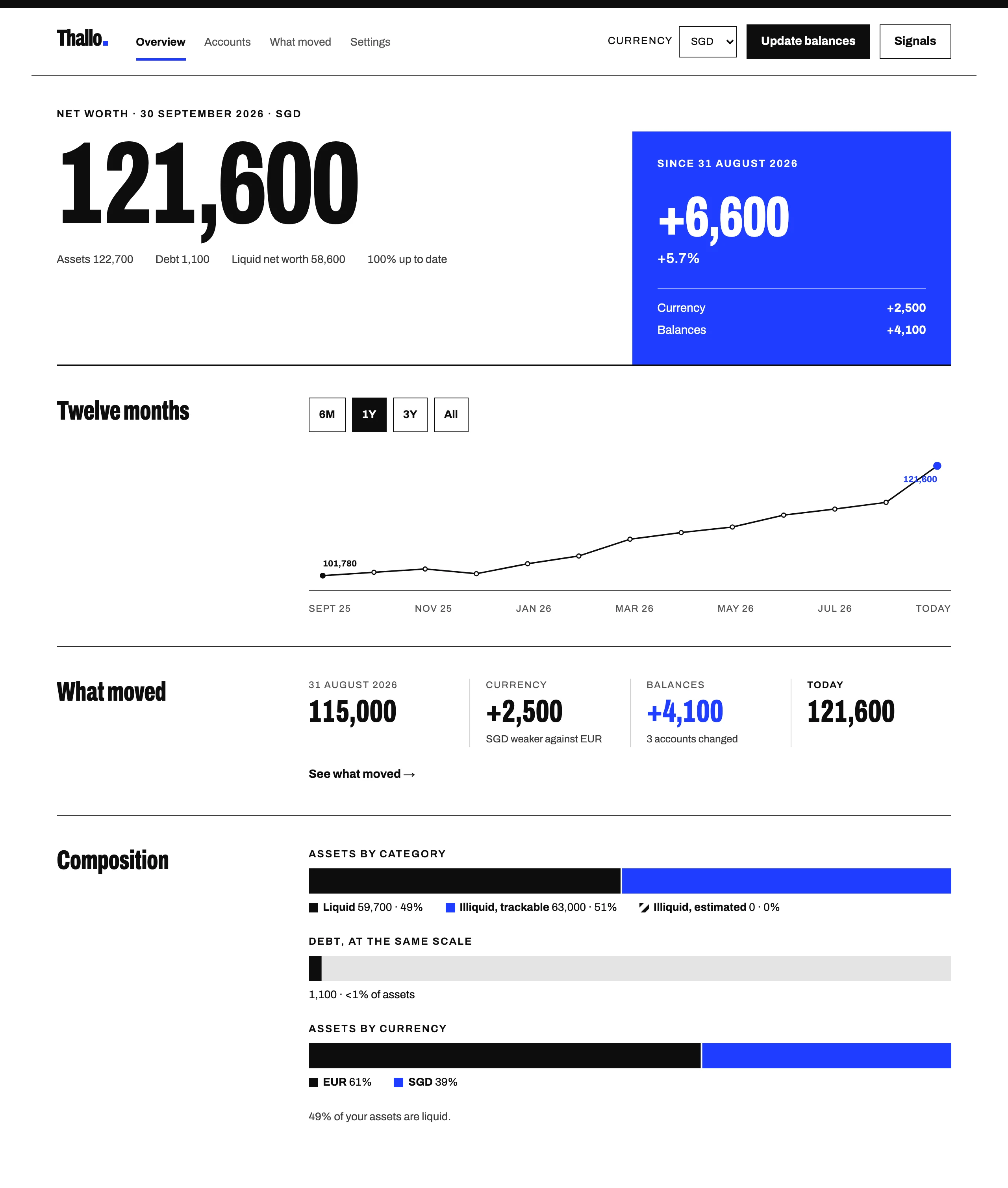
Where the September rise came from
Account by account, the SGD 6,600 for 31 August to 30 September splits like this:
| Account | Currency effect | Balance changes |
|---|---|---|
| Singapore current account | SGD 0 | +SGD 2,500 |
| Singapore brokerage | SGD 0 | +SGD 1,200 |
| French pension | +SGD 2,100 | SGD 0 |
| Livret A savings | +SGD 400 | SGD 0 |
| Credit card | SGD 0 | +SGD 400 |
| Total | +SGD 2,500 | +SGD 4,100 |
The currency effect is the starting balance times the change in the rate. For the pension that's EUR 42,000 × 0.05 = SGD 2,100, and for the Livret A it's EUR 8,000 × 0.05 = SGD 400.
What moved shows the two euro lines together, as one EUR row of +SGD 2,500, and lists the three accounts whose balance changed.
Balance changes came to SGD 4,100. That's mostly her own saving and spending, but SGD 1,200 of it was the market in the brokerage.
The pension still showed its March balance, with the date next to it. It wasn't marked out of date, because a yearly account last updated in March is on schedule. Its value in Singapore dollars still went up, because those euros would buy more Singapore dollars at the end of September than at the end of August.
Her Signals that week included a line close to this: "The euro rose against the Singapore dollar in September. That added about SGD 2,500 to your euro accounts."
The same month in euros
She switched the display currency to EUR to compare. In euros, her net worth went from about EUR 79,310 to about EUR 81,067, up EUR 1,756. The currency effect was now about −EUR 977, because her Singapore dollar accounts bought fewer euros, and balance changes came to about EUR 2,733.
The same exchange rate move added to her total in Singapore dollars and took something off it in euros. Which way it goes depends on the currency you measure in, so she keeps her display currency as SGD, the currency she earns and spends in.
When the pension statement comes in March, she'll enter the new balance. What moved will then show how much of the pension's change over the year came from the euro and how much from the pension itself.
Start free, and add your pension at its last statement value.