Thallo vs Kubera
Kubera and Thallo are both balance sheets. Each tracks everything you own and owe, in many currencies, and neither does budgets. They differ mainly in how the numbers get in and in what each one shows you about the total.
Kubera does a lot of the work of collecting your numbers. It connects to banks and brokers, values your home by address and your car by model and year, and follows stocks by ticker. With Thallo you type in a balance for each account when you have one, and Thallo shows you what changed the total, how up to date it is, and a few things each week that might be worth a look.
If you want most of your numbers to update themselves, with investment detail on top, Kubera does that, and it costs USD 250 a year. If you're happy to type in your balances once a month, Thallo is free during early access and will become a paid service later, with notice.
Side by side
Kubera's column comes from its own site, checked on 5 November 2026.
| Thallo | Kubera | |
|---|---|---|
| Multi-currency net worth | Yes, with daily rates from central banks and official sources | Yes. Their site says any currency, at every layer |
| Handles property, cars, art | Yes, as your own estimate | Yes. Homes valued by address, cars by model and year, art and watches through price feeds and an AI appraiser |
| Explains currency vs balance change | Yes, in What moved | Not stated on their site |
| Tracks individual holdings | No | Yes. Stocks by ticker, crypto by wallet, IRR on fund positions |
| Budgeting | No | No |
| Works without bank logins | Yes. Thallo never connects to banks | Yes. Kubera's FAQ says plenty of people run it entirely by hand |
| Price (5 November 2026) | Free during early access | USD 250 a year (Essentials) or USD 2,500 a year (Black). 14-day trial |
What the overview shows
Thallo's overview starts with your net worth and how much it has changed since the last month-end, with a 12-month line underneath. You can split the total into four categories. They are Liquid (cash, brokerage, crypto); Illiquid, trackable (a pension or deposit where someone else reports the number); Illiquid, estimated (a car, art or property you value yourself, marked ≈); and Debt.
It also shows your liquid net worth, which is your liquid accounts minus your debt. Next to that are two ratios: how much of what you own is liquid, and how your debt compares with your assets.
What changed and why
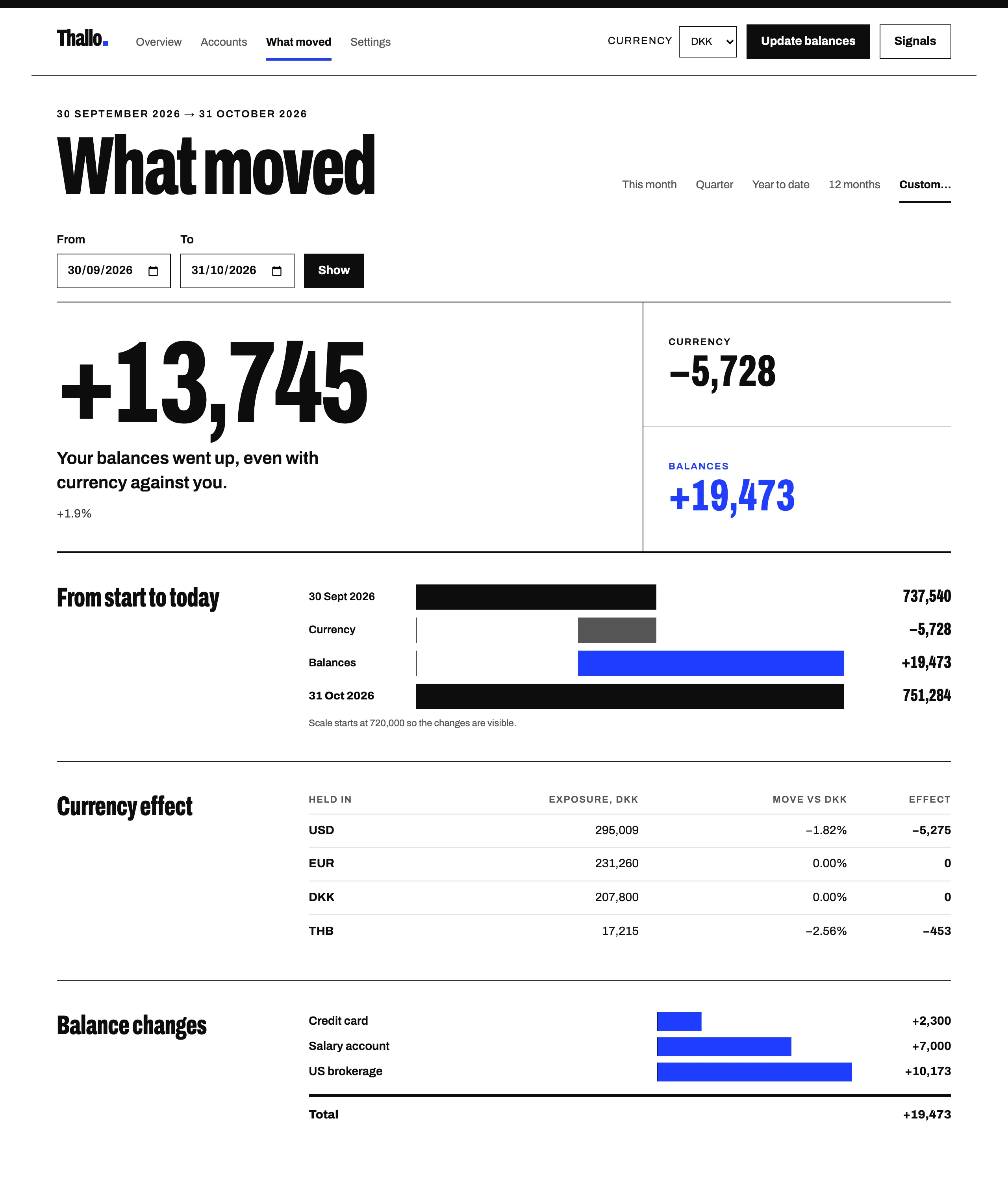
Kubera converts every account and says it restates your history when rates move. Thallo converts at each day's rate too, and What moved splits every change into the part from exchange rates and the part from your balances.
For example, with DKK as your display currency, a THB 400,000 rental deposit in Bangkok stays the same while the baht slips from DKK 0.200 to DKK 0.195. The account drops from DKK 80,000 to DKK 78,000, and What moved shows the DKK −2,000 as currency effect, separate from anything you saved or spent. A loan in another currency is split the same way, into what you paid down and what the exchange rate did. (Illustrative numbers.)
We couldn't find a page on Kubera's site that describes a split like this. If there is one, tell us and we'll fix this page.
How up to date your total is
Because you enter the balances, Thallo keeps track of how current they are. You choose an update rhythm for each account, from weekly to yearly, and an account is marked as out of date once it's overdue. The overview shows the share of your total that's current, for example 91%, so you know how much weight to put on this month's figure.
Signals
Once a week, Thallo puts together a short list of three to five things worth a look. One might be that the dollar fell against your display currency this month, with what that cost you. Another might point out two accounts that moved in opposite directions, in case you moved money between them. Thallo's own code finds and calculates every figure, and an AI model (Claude, from Anthropic) writes the sentences. To do that, a summary of your figures is sent to Anthropic. Signals are on by default and never give investment advice, and you can switch them off in Settings.
Where Kubera does more
Kubera runs several aggregators and picks one per institution, and for sites that won't connect, its Web Sync reads the balance off the website. Once that's set up, most of your net worth stays current without any typing. Kubera says it never stores your banking credentials and can't move your money.
It follows stocks and funds on exchanges in the US, Canada, the UK, Europe and Asia. It also tracks private fund commitments, calls and distributions, works out IRR, and shows your growth as a CAGR next to the S&P 500.
The Black plan adds ownership tags across people, trusts and entities, nested portfolios, and 1:1 calls with the same person each time. Kubera also has iPhone and Android apps.
Thallo has none of these. A brokerage account is one number, the car and the house are your own estimates, and joint ownership isn't built yet. It runs in the browser on phone and desktop, and it doesn't connect to banks and isn't planning to.
Moving from Kubera
Kubera's site says you can export anything to a spreadsheet, so start there. Copy the balances into Thallo's net worth spreadsheet template, with one row per account and one column per month-end, and import it when you sign up. The file is opened in your browser rather than uploaded, and only the accounts and balances you confirm are saved. Then give each account an update rhythm.
Kubera has a 14-day trial with everything switched on, so you could also run the two side by side for a couple of weeks.
Questions
Does Kubera do budgeting?
No. Its FAQ says it's a balance sheet, not a budget. Thallo doesn't do budgets either.
Does Thallo track my individual stocks?
No. Thallo keeps one balance per brokerage account, in that account's currency. For positions, dividends or cost basis, use your broker, Kubera or Sharesight.
When you're ready, you can add your first few accounts and see your overview.